
In the field of asset allocation, relying entirely on a single asset class exposes a household portfolio to localized market shocks. The historical market cycles of 2008 (the Global Financial Crisis) and 2020 (the COVID-19 pandemic liquidity shock) serve as clear case studies on how market-linked equity instruments behave during macroeconomic stress.
For long-term investors, building a resilient transaction framework requires understanding the relationship between differing asset categories. Examining the historical interaction between domestic equities (represented by the Nifty 50 index) and gold highlights the mechanical value of asset diversification.
🔄 Part 1: The Performance Duality of Two Distinct Asset Classes
To achieve true structural balance, an investor must look at how different financial instruments react to the same economic triggers. Equities and gold generally operate on an inverse or low-correlation baseline:
1. Large-Cap Equities (Nifty 50 Tracking Funds)
-
Primary Driver: Equity mutual funds tracking the Nifty 50 index are intrinsically tied to India’s corporate earnings, structural economic expansion, and industrial productivity.
-
Behavioral Profile: Over extended horizons, equities provide a pathway to participate in economic growth. However, they are subject to sharp short-term volatility and structural market corrections during global or domestic macro shocks.
2. Gold Mutual Funds & ETFs (The Strategic Hedge)
-
Primary Driver: Gold behaves fundamentally as a systemic “safe haven” and a store of value. It does not rely on corporate balance sheets, quarterly cash flows, or industrial earnings.
-
Behavioral Profile: Historically, during severe capital market contractions, global liquidity shifts toward low-risk repositories. As fear indices rise and equity benchmarks compress, gold prices frequently witness upward momentum, acting as a natural accounting buffer against equity drawdowns.
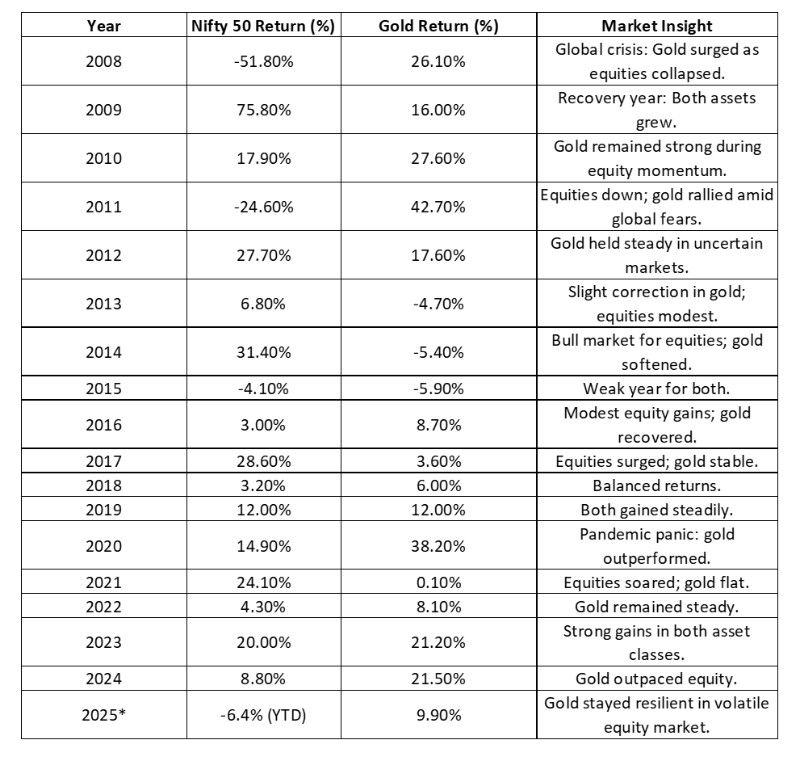
🧮 Part 2: Visualizing Non-Correlation (A Case Study in Diversification)
Consider an objective look at two hypothetical asset layouts initiated just prior to the market contraction of early 2020, each deploying a baseline capital of ₹1 Lakh:
-
Layout A (Concentrated Base): Capital was deployed 100% into a diversified Nifty 50 index tracking fund. When the macro correction triggered in March 2020, the absolute valuation of this layout contracted symmetrically with the index, experiencing full short-term market volatility.
-
Layout B (Diversified Base): Capital was split structurally—allocating ₹90,000 to the Nifty 50 tracking fund and ₹10,000 to a regulated Gold Mutual Fund.
During the correction phase, while the equity allocation in Layout B faced short-term paper depreciation, the appreciation in the gold fund allocation mathematically mitigated the net percentage drawdown of the total portfolio base. This process is a purely mathematical result of asset non-correlation, not speculative timing.
🛠️ Part 3: Operational Advantages of Modern Gold Instruments
For modern investor awareness, allocating capital to gold no longer requires handling physical bars or jewelry, which carry severe operational leakages. Instead, regulated digital transaction pathways provide streamlined execution:
-
Purity & Storage Safety: Gold Mutual Funds and Exchange Traded Funds (ETFs) trade electronically. This eliminates risks associated with physical theft, bank locker fees, and structural deductions for melting or making charges.
-
Frictionless Liquidity: Units can be partially or fully redeemed electronically through your transaction portal, settling into your linked bank account via standard regulatory timelines (T+2 business days), avoiding the opaque pricing of physical bullion dealers.
-
Systematic Execution: Investors can set up an automated Systematic Investment Plan (SIP) in Gold Mutual Funds, allowing them to average their acquisition costs across commodity cycles exactly like equity instruments.
💡 The Operational Takeaway
Gold is not designed to compete with the long-term growth potential of equity mutual funds; rather, it serves a completely different structural function within a household portfolio. By understanding the low correlation between corporate earnings (equities) and systemic safe havens (gold), investors can utilize regulated distribution channels to map out a balanced, mathematically sound asset framework that maintains structural consistency across changing economic seasons.
⚠️ Mandatory Statutory Disclosure & Disclaimer:
This article is issued strictly for investor education and awareness purposes and does not constitute financial advice, investment research, a formal financial plan, or a specific product recommendation. Datta Alekar / Paisalogy acts strictly as an AMFI-Registered Mutual Fund Distributor (ARN-248117). We provide transaction routing, digital tracking interfaces, and suitability mapping services; we are NOT SEBI-Registered Investment Advisers (RIA) or Portfolio Managers (PMS), and we do not offer return guarantees or specific asset allocation percentages. The historical references to the market cycles of 2008 and 2020, as well as the numerical illustrations provided, are entirely for educational purposes to demonstrate the mathematical concept of asset non-correlation. Past performance of any index or commodity is not a reliable indicator of future market results. Mutual Fund investments are subject to market risks; please read all scheme-related documents carefully before executing any transactions.



Leave A Comment